
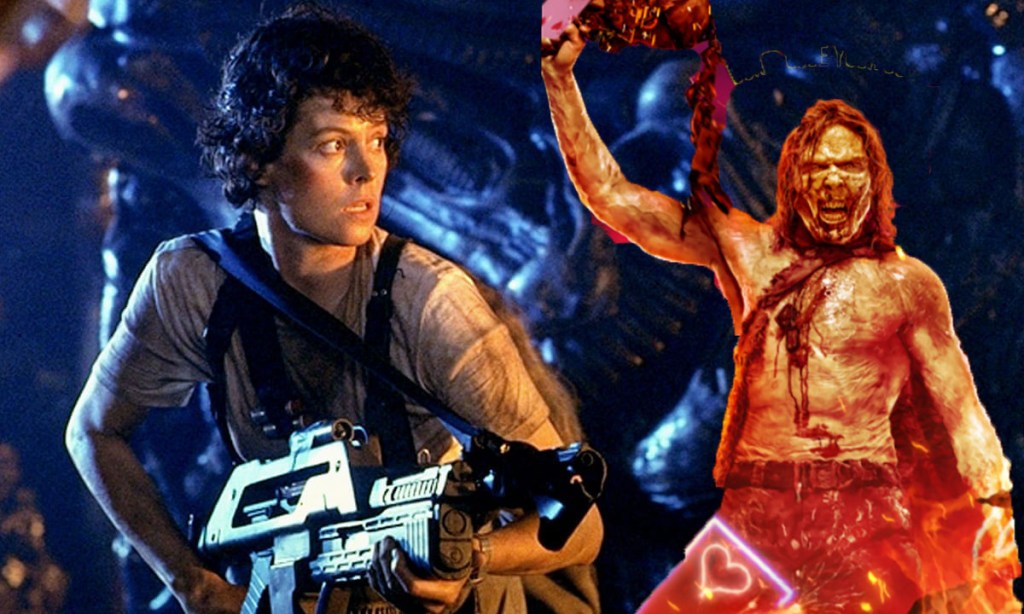
When Scott, Kate, and Geeta ran out on the rooftop to find that their pilot Peters had left them to the zombies and the nuke in Zack Snyder’s Army of the Dead, I could practically hear Ellen Ripley’s voice in my head: “BISHOP! GODDAMN YOU!” This was only hammered home when Peters made a triumphant return moments later, as Bishop did in James Cameron’s Aliens.
That was far from the only homage to Aliens in the latest zombie movie on Netflix. As someone who prepared for this movie by watching an abundance of zombie movies, from George Romero’s Night of the Living Dead to Yeon Sang-ho’s Train to Busan, I was surprised to find the movie was more of a tribute to Cameron’s classic sci-fi action film than any zombie movie. Army hits many of the same story beats as Aliens and addresses similar themes of parenthood. The two movies diverge in many ways as well, with Snyder taking themes present in Aliens even further. Not quite improving on Cameron’s masterpiece, but arguably posing a bolder question about “monsters” in film.
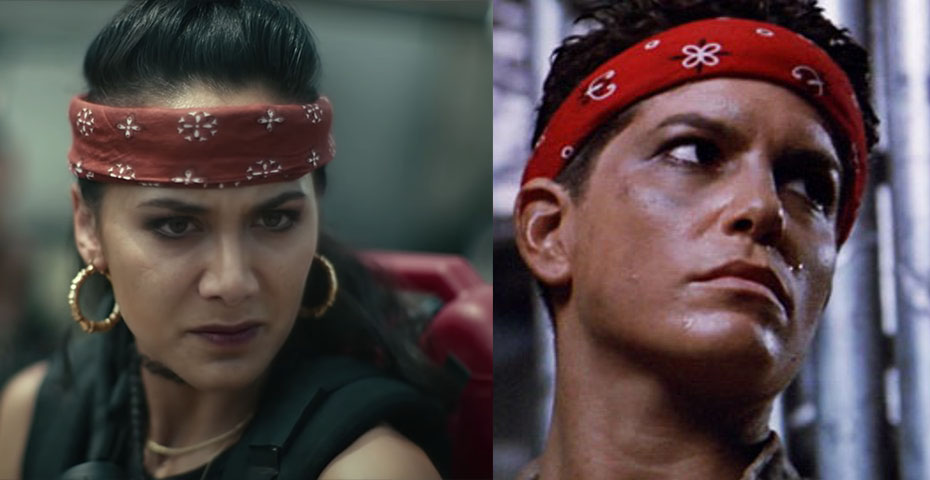
The surface level references are hard to miss. Snyder and costume designer Stephanie Porter included nods to Aliens in the costume design. The most obvious being the red bandana that Samantha Win wears as Chambers, the ride or die companion to Raúl Castillo’s Mikey Guzman. The bandana, as well as Win’s oiled up muscles, clearly invokes Jenette Goldstein’s iconic Lieutenant Vasquez. The friendship between Chambers and Guzman is also reminiscent of Vasquez’s relationship with Mark Rolston’s Drake, down to one of them being forced to watch the other die. Another costume that may have been a nod to Aliens is Kate’s, with the gray pants and white shirt, she looks reminiscent of Sigourney Weaver’s Ripley in the iconic elevator scene. With costume decisions such as these, you’re aware from early on that Snyder had Aliens on his mind while filming this zombie movie.
As for the story, Army of the Dead has a similar premise to Aliens and hits a few of the same beats. A group of characters enter a dangerous place, come into contact with another species that they underestimated, and they have to get out before the location explodes. Along with that, we have the classic comeuppance for the character who double crosses the team and leaves them for dead. These tropes are not specific to Aliens or Army of the Dead, but due to all the visual references made to Aliens, and even strikingly similar lines, it was the movie I was thinking about throughout my viewing experience.
While both movies have a band of characters going into a dangerous zone, in Aliens it’s a military operation. The unit is portrayed as overconfident (Bill Paxton’s Hudson brags “I am the ULTIMATE badass!”) as half of them get wiped out in their first contact with the xenomorphs, but ultimately, we see that they are capable. Their mission is also intended as a rescue, though by the time they arrive, the only person left to rescue is a little girl, Newt. The military characters in Aliens, while arrogant, are still shown in a positive light. This is in contrast with Army of the Dead, in which the military is responsible for the zombie outbreak and portrayed as incapable and even incompetent in their efforts to contain it. We see parachuters jump right into a sea of zombies and ripped to shreds when they reach the ground. It is civilian volunteers, the leads in Army, who are most capable of fighting the zombies and saving people, including the Secretary of Defense. The military is not only portrayed as incompetent, but nefarious, as we discover that they had a hand in double crossing the team (who themselves are there to steal money and only happen to rescue Geeta due to Kate’s stubbornness) and leaving them for dead in order to make away with the head of a zombie alpha for their own sinister purpose.
While there are contrasting views on the military in these two movies, Cameron and Snyder both make the case that perhaps the “monster” antagonists in their respective movies aren’t the true bad guys. Snyder included Ripley’s line from Aliens word for word “You don’t see them fucking each other over.” In both movies, that line is said to the character that double crosses the team. Burke in Aliens, who locks Ripley and Newt in a room with face-huggers so they can be brought back to earth, and Martin in Army, who cuts off the queen zombie’s head so it can be sold to the U.S. military. Both Burke and Martin leave the team for dead as they’re being ambushed, only to meet their own demise moments later. While the xenomorphs and the zombies are violent towards and kill humans, it is their nature, and necessary for survival (though Snyder presents the possibility that zombies can perhaps survive without humans). Face-huggers lay their eggs in humans. Zombies bite and eat humans. But they don’t kill or seek or harm their own as we see both Burke and Martin do, at least not that we see. Hence both Lily and Ripley’s impression that humans are hardly any better than the “monsters,” if at all.
While Cameron certainly plays with the idea that the xenomorphs are not the true villains, I would say unequivocally that Snyder takes it much further with his zombies. This is due in part to the fact that we are naturally more inclined to sympathize with a zombie than a xenomorph. Xenomorphs were brilliantly designed in the original Alien to be the stuff of nightmares. Zombies, on the other hand, were once human and look human. Another feature of xenomorphs is their aggression towards humans. They seek them out as hosts for their face-huggers to continue their race. In many zombie movies, that is also what the zombies do: attack humans and eat them, though they’re not quite as proactive as the xenomorphs in doing so, as xenomorphs are intelligent. But Snyder’s alpha zombies are another departure from the usual zombie lore, they are “smarter, faster, organized” as Lily tells us.
One would think, as I did going in, that perhaps the zombies in Army would be capable of escaping Vegas, and maybe they have a plan to do so. But as Snyder has stated repeatedly since the movie’s release, the alphas are “not ambitious.” They have no desire to escape Vegas. It is their “kingdom.” We get the impression that really, the zombies want to be left alone (how that works with their eating habits, I’m not sure). They are aggressive towards humans, as they will sometimes take trespassers to the hotel where they reside to be bitten and turned, but they’re also capable of making deals with the humans who enter their kingdom and leaving them alone if the humans respect them. Between zombie alphas and xenomorphs, the xenomorphs are far more outwardly aggressive towards humans. Though they will take innocent victims such as Geeta, it was the government’s terrible treatment of her and the other refugees that drove her into Vegas in the first place. When the zombies attack our team of humans, they only do so because the humans broke the deal with them, beheading the zombie queen and killing her unborn child, fathered by Zeus, the leader. Yes, zombies are capable of procreation in this universe, raising the interesting idea that zombies no longer need human hosts to survive, suggesting that they could replace humans as the dominant species.

Army of the Dead and Aliens both have strong themes of parenthood. In Aliens it’s motherhood, in Army it’s fatherhood. In Aliens, Ripley discovers early on that while she was floating through space in hyper sleep, her daughter had grown old and died. Then while on the rescue mission, she meets Newt and immediately forms a connection with her, culminating in Newt calling her “mommy” at the end after Ripley saves her. Scott’s relationship with his adult daughter is rockier. Their relationship is strained due to his absence from her life after she watched him kill her zombified mother. Much of Scott’s arc in the movie revolves around wanting his daughter’s forgiveness, offering her fifteen million dollars of the heist money and agreeing to allow her to come along on the mission to look for Geeta who had disappeared in the city. While Ripley had been absent from her daughter’s life through no fault of her own, Scott was absent from Kate’s life due to his own fears of facing her, permanently damaging their relationship and setting off the tragic events of the movie.
Our “monster” antagonists in both movies are also parents. The xenomorph queen lays the face-hugger eggs. Zeus had a baby with his queen. In both cases, their offspring die at the hands of humans. However, an important distinction is that Ripley, the hero of the movie, is the one to set the queen’s eggs on fire. Whereas in Army it is Martin, a clear shady character and ultimately the villain, who is the one to behead the queen and kill the baby. Ripley’s actions are understandable as one of the eggs opened right in front of her, and a face-hugger could have jumped on her or Newt. But killing all of the eggs wasn’t necessary, and the queen wants revenge for that. The movie doesn’t condemn Ripley for this choice because again, xenomorphs are more outwardly aggressive towards humans. In Army, all of the characters are punished for Martin’s choice. Almost the entire team is wiped out because of what he did. We also see the emotional toll the loss of the baby takes on Zeus, reducing him to tears. Army goes much further in asking us to sympathize with this loss than Aliens did.
The parents, human and “monster,” in each film come to a physical confrontation in the climax of both films. Both the xenomorph queen and Zeus follow the human characters and hitch a ride on their escape plane or helicopter and proceed to attack them. In both cases, the “monster” is arguably seeking vengeance over the death of their children. However, once again the xenomorph is clearly portrayed as more monstrous, attacking Bishop unprovoked and setting her sights on Newt. Zeus, on the other hand only attacks Scott, who he had previously seen with Lily and his queen’s head, when he jumps in the helicopter. Zeus’s attack is about the loss he has suffered, in part because of Scott’s actions. Scott, a father himself and a poor one at that, played a role in the death of Zeus’s baby and his queen, and Scott suffers the consequences for that when Zeus bites him. Our two fathers kill each other. In contrast with Ripley, who successfully kills the queen xenomorph and saves the remaining crew. Everything about the climactic scenes makes it apparent which characters are in the wrong. In Aliens we’re not meant to think Ripley had done anything to deserve death by the xenomorph queen, while Scott dies for his role in the zombie queen and her baby’s death.

Burke: This is clearly an important species we’re dealing with here, and I don’t think you or I or anybody has the right to arbitrarily exterminate them.
Ripley: Wrong!
Vasquez: Yeah, watch us.
That exchange between Burke, Ripley and Vasquez best exemplifies where Aliens and Army of the Dead diverge. While in Aliens the decision by a group of people who had just been horribly attacked by the xenomorphs to nuke them seems justified, in Army of the Dead, the decision is made by the government, and it seems far from a fair solution. As the zombies were created by humans, locked up by humans, and then (the alpha zombies) only wanted to be left alone. The only humans that fell victim to the alphas either betrayed the zombies or went into Vegas due to the poor conditions the government put them in. The decision to kill the xenomorphs is never a moral dilemma, but a necessity. The zombies in Army, who seemed to want to be left alone and have children of their own, were viewed as a threat that had to be wiped out despite being created by the government, and were only a threat to humans because of how the government treated their refugees and former civilian rescue teams. So, while Aliens may dabble in the idea that the “monsters” aren’t the real monsters, it makes a clear stand when it wipes them all out, something our heroes endorse. Army of the Dead swings at the idea much harder, harder than most movies in this genre. “Humans are the real monsters” is not a new theme, but where Snyder’s movie truly sours is in the implication that the monsters are not monsters.
 Liztalks.com