

Trigger warnings for discussions of sexual assault and abuse.
Stabbed in the mouth or shot in the back, Adam Driver’s characters did not make it out of either of Ridley Scott’s movies this year alive. Both characters were based on real men, and the movies, The Last Duel and House of Gucci, based on true stories. Jacques Le Gris died in the last legally sanctioned duel in France, killed by his former friend Jean de Carrouges. Maurizio Gucci was gunned down by a hired hitman on his office steps in Italy. While one man lived in medieval France and the other only a few decades ago in Italy, both men died in large part because of their actions towards women.
I do not know if Ridley Scott intended for The Last Duel and House of Gucci to be in conversation with each other, but they are two female led movies directed by him that came out in the same year that include heavy themes of patriarchal societies. The fact that Adam Driver dies in both movies is almost humorous in its consistency. With all of this, it is difficult not to compare them. The female leads are entirely different, Adam Driver’s characters are not alike, but I believe there is a lot to be said about how both Jacques and Maurizio meet their ends, and the women who they wronged to get there.
Jodie Comer’s Marguerite de Carrouges enters The Last Duel walking submissively behind her father while Matt Damon’s Jean eyes her with interest. Lady Gaga’s Patrizia Reggiani struts onto the screen in House of Gucci basking in the catcalls of all the men working at her father’s trucking company. The contrast between the two women is immediately plain to see, and what you would expect considering the two lived six hundred years apart. Patrizia has a job and independence. She is comfortable in her sexuality. Marguerite is the property of her father, and then her husband. Patrizia pursues Maurizio with vigor and relishes the sex she has with him. Marguerite is given to Jean by her father and never finds an ounce of enjoyment in sex with her husband. Both women will find themselves struggling with the men in their lives; the struggle to be seen and heard.
Adam Driver’s characters Jacques Le Gris and Maurizio Gucci are perhaps even more different from each other than Marguerite and Patrizia. Jacques basks in his place as a count’s favorite. He is an ambitious social climber and has all the confidence in the world, particularly when it comes to women. Maurizio lacks all ambition. He does not seem comfortable with his place in the Gucci family and attempts to separate himself from the name. Jacques is a lion, with the long flowing hair to match. Maurizio seems like a lamb.
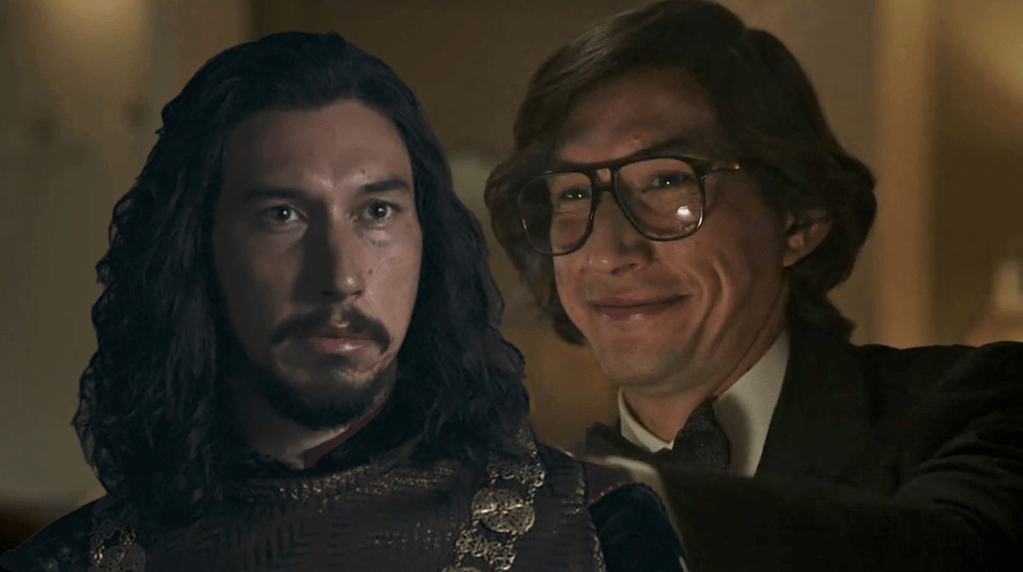
What can two entirely different men do to women that leads both to an early demise? With Jacques, the answer is more straight forward. Jacques rapes Marguerite and dies in a duel that was meant to decide who was telling the truth. Whoever won had God on his side. Jacques lost; therefore, he was a rapist. While Jacques may not have seen what he did to Marguerite as rape, and he denies the crime to the very end, her perspective shows the audience just how horrifying the experience was for her. Marguerite wants justice for what was done to her, but she does not want a duel. She does not want Jacques to die, but rather answer for his crime in the courts. It is Jean who demands a duel, at the risk of his wife’s own life (she’ll be burned at the stake if he loses) because he had many scores to settle with Jacques long before he assaulted his wife. Marguerite’s pursuit of justice inadvertently causes Jacques’s death.
While Patrizia does not pull the trigger on Maurizio, she directly causes her husband’s death by hiring the hitman. Unlike Marguerite, she wanted him dead. Maurizio’s actions against Patrizia were not nearly as gruesome as what Jacques did to Marguerite. In fact, in the movie’s first act, Maurizio is an easy character to root for. He’s awkward and shy. You can see why Patrizia is taken with him. It is only when Patrizia oversteps her bounds and makes morally questionable decisions to further herself that Maurizio’s behavior towards her changes. Patrizia concocted a plan to send Maurizio’s uncle to prison so that they might have more control over the Gucci empire. After a confrontation with Maurizio’s cousin Paolo in which he makes his rage known, Maurizio becomes cold towards her. He embarrasses her in front of his friends. He blames her for what she has done to his family. He has an affair with a woman he had known much longer. Ultimately, he divorces her, without even giving her the decency of telling her himself.
Something Jacques and Maurizio do have in common in these movies is a complete refusal to take responsibility for their actions. Jacques, as previously mentioned, denied assaulting Marguerite to the end, even when Jean had a knife to his face (this is true to what really happened). To him, it was a consensual encounter. He never believed for a second that he could have raped a woman, because he never truly considered her feelings. He’s stunned, and even hurt, that she would say it was not consensual. Maurizio, who was consistently portrayed as meek and even cowardly throughout the movie, finds it easy to dump all his family’s problems on Patrizia. They forged his father’s signature, they sent his uncle to prison, they snatched away Paolo’s dreams of being a designer. Patrizia certainly got the ball rolling on these plans, but when Maurizio must face the music, he can’t do it. He passes the blame off on her and slams her into a wall and mocks her when she berates him for his timidity. Somehow both men can put the blame for their actions on the women. Marguerite must have been confused, or felt guilty for committing adultery, so she called it rape. Patrizia is a gold-digging hustler like his father said, so she made Maurizio tear his family apart. Never mind the fact that Marguerite put herself at risk by accusing Jacques, or that Maurizio continued his plans to take the company from his family long after he left Patrizia.
Perhaps my favorite moment in House of Gucci is when the scheming lawyer played by Jack Huston finally reveals to Maurizio that he had been vying for his position all along. Maurizio, outmatched and outplayed, with an exasperated smile on his face, says “She was right about you.” Patrizia had clocked Huston’s character from the first act of the movie, spotting him for the wolf in sheep’s clothing that he was. Had Maurizio listened to his wife, he may not have failed spectacularly as CEO. He only sees the truth when he’s smacked in the face with it. Similarly, it took a horrific duel and Jacques’s death for anyone to truly believe Marguerite, even her husband. Had everyone believed Marguerite, and listened to her pleas against a duel, such violence could have been avoided. Maurizio and Jean both charge headfirst into catastrophe. Jean just happened to win his battle.
Ultimately, Marguerite and Patrizia are both pawns in a man’s game in a man’s world. Easy to brush to the side or kick to the curb when they are not needed. They both try to garner the little power they have, through their husbands, and don’t get the result they wanted. Marguerite has no legal standing without Jean. The crime of rape was not a crime against her but a crime against her husband. Jean does pursue legal action, as she wanted, but he uses her accusation for his own revenge, against her wishes. He ends up a hero for his victory in the duel; his wife a mere trophy to show off to the crowd. Patrizia tries to find success and power through her husband’s name. But she flies too close to the sun. She does a lot of the work to further Maurizio, to the detriment of her marriage. He ends their marriage and then reaps the benefits of the dirty work she did for him. Marguerite and Patrizia both made the mistake of thinking they mattered to their husbands more than they actually did. But in Patrizia’s case, she killed him for it.
 Liztalks.com