

When Rachel Zegler’s Maria began to dance around Tony in Steven Spielberg’s West Side Story, it was immediately apparent that Spielberg had upped the angelic imagery of Maria beyond what we’ve seen on screen before. The dreamlike lighting, Maria’s flowing white dress, Tony’s stoic nature receding as he begins to dance with her, Maria is ethereal in this scene. She is practically floating around Tony, just out of reach until he takes her hand and pulls her to him. It is difficult to mistake the meaning of the scene, conveyed through the choreography. Maria is the good and the pure and Tony is the boy with the troubled past who had been told to look for something better. Maria is that something better.
None of this is new to West Side Story. This is the core of the story, originally conceived by Jerome Robbins, Arthur Laurents, Stephen Sondheim, and Leonard Bernstein in the original musical. We have seen this story on stage and in the much-lauded 1961 movie directed by Robert Wise and Jerome Robbins, starring Natalie Wood and Richard Beymer. Spielberg never strays too far from what is familiar in his depiction of the two leads. Wood’s Maria was also kind and good natured, though noticeably older than Zegler’s Maria, as Wood was in her early 20s when she shot the movie, in contrast with Zegler who was only eighteen. Zegler’s Maria comes across younger, and perhaps a bit more cynical, as she spars with Tony about how Puerto Ricans are treated in New York. We are also treated to a scene of Maria standing up to her older brother Bernardo, which we never saw in the 1961 version. Maria is more of a spitfire in Spielberg’s version than we have seen before. Despite their differences, both versions of Maria fit nicely into The Ingenue archetype, a young virginal woman whose purity inspires the characters around her to feel they must protect her.
Where Maria has a few changes to her personality in Spielberg’s movie, Tony has perhaps the most dramatic change compared to the 1961 version. Beymer was an unabashed delight as Tony, with a smile that could make anyone’s heart melt. His Tony was a reformed gang member, true to the original story, and gets pulled back in by his best friend Riff. All of this is the same in Spielberg’s movie, but they go to greater lengths to show us that Tony was, and probably still is, dangerous. Rather than quitting the Jets because he was ready to move on, Tony was sent to prison for almost beating a man to death. It was in prison where he looked inward and chose to change for the better. While there is always a sense that Beymer’s Tony was willing to throw a punch, Spielberg’s Tony is often on the verge of losing control. Overall, this change worked for me. While I love Beymer’s Tony, I didn’t always buy him as a former gang member. With Spielberg’s Tony and this new backstory, I did.
This change in Tony’s character made the “good girl bad boy” trope a lot more prominent in Spielberg’s version. Beymer’s Tony, as mentioned, came across as a reformed bad boy and a sweetheart. Spielberg’s Tony is far from reformed. He still seems to be working on himself. Enter: Zegler’s Maria, a little more cynical perhaps, and forward in her intentions (she practically jumps on him in their first kiss) but still the kindhearted and innocent young woman we know. Couple that with the fact that Tony is obviously more experienced with women, compared to Maria’s minimal experience with men, and we have a straightforward good girl with the bad boy scenario.
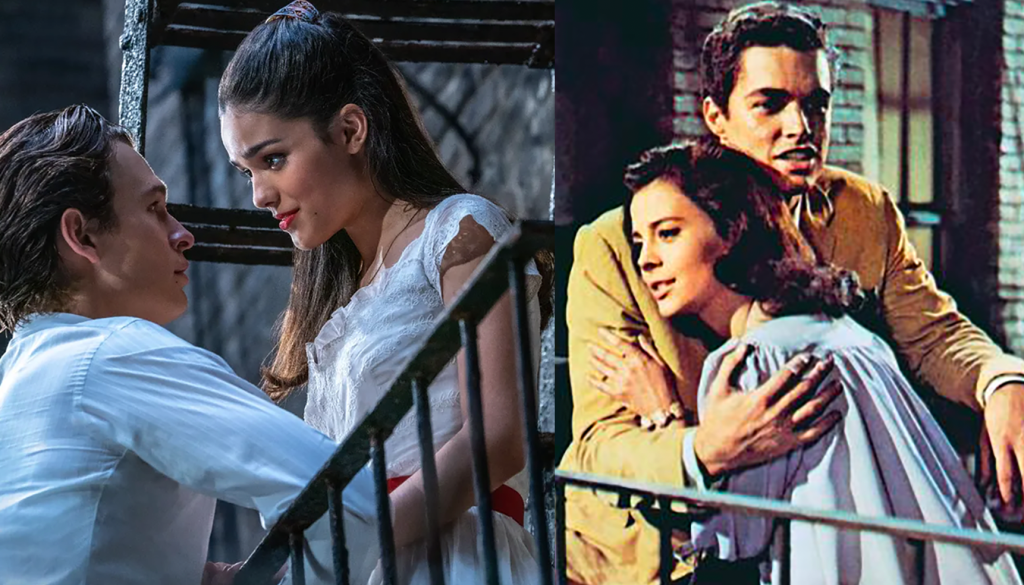
This is Romeo and Juliet. Tony and Maria’s attachment is due in large part to the fact that they are soulmates. The world disappears when they look at each other. When Maria sees Tony, that is it, and vice versa. But in West Side Story, Tony’s attachment to Maria goes beyond that, and Spielberg’s movie explains it more than once. Once by Tony and once by Bernardo. Tony tells Maria about how he almost beat a man to death, and how since then he always felt like he was “about to fall off a building” but that feeling went away when he saw her. Maria, we see, makes him feel safe, like he won’t hurt anyone ever again. In other words, she makes him better. We don’t ever hear about Maria’s feelings when she looks at Tony. Her attachment is simply their soulmate connection, and a more cynical perspective would suggest that Tony is the bad boy that her brother told her to stay away from, so of course she wants him more than anyone else. But what is important here is Tony’s desire for Maria is always more thought out by the screenwriters, for both movies, than Maria’s desire for Tony. This is likely because Maria’s attachment to a gang member is harder to explain than Tony’s attachment to a kind young woman who is obviously good for him. But is Tony good for Maria? “I can fix him” is a funny trope on social media, but a bit harder for screenwriters to capture in a romantic way. In West Side Story, they don’t try it.
West Side Story has always faced criticism for the actions the two leads take at the climax of the movie not being believable. For Tony, when he kills Bernardo. For Maria, when she forgives Tony for killing her brother within an hour of it happening, has sex with him, and resolves to run away with him. As this is a loose adaptation of Romeo and Juliet, and as Bernardo is the Tybalt of this story, these actions were necessary to stay in line with the original story, but does the narrative support these decisions? In Tony’s case, I would argue yes. I have always found it believable that in a moment of rage after seeing his best friend die in front of him, he would kill Bernardo. Tony is, after all, a former gang member and no stranger to violence. With Spielberg’s Tony, it is even more believable as he had almost killed someone before. The far more controversial choice made in this story is Maria’s.
Critics of West Side Story have never been able to get past the idea that Maria would forgive Tony so quickly, let alone have sex with him, right after he killed her brother. This I understand. I think it is perhaps one of the craziest decisions I’ve ever seen a character make. Though I’m willing to suspend my disbelief when I remember the “soulmate” fact of their relationship, the fact that Maria (and Tony as well) was undoubtedly in an extremely vulnerable state after the death of her brother, the fact that they were both teenagers, and in Spielberg’s version, without her parents around, she may have felt an even stronger attachment to Tony. This narrative choice has been criticized because it seems in contrast to who Maria is: a good person. The story spends so much time showing her to be this pure soul, and she does something so in contrast to that. But Maria’s decision itself is, in my opinion, not the problem here. It is how that decision is handled by the narrative.
While Maria is not an evil person for the decision she makes, it is still a decision that would have devastated her brother and did devastate Anita, the woman that was as close to her as a sister. Anita is allowed some outrage for Maria’s choice. In Spielberg’s version, she slaps her in the face. A Boy Like That is a song that exists for Anita’s rage towards Maria, but it does not last. Soon, Maria flips the script on Anita, questioning whether Anita truly loved her brother, because Maria thinks if she had, then she would understand Maria’s forgiveness of Tony. Anita listens and soon, they’re singing together about both of their loves, culminating in the lyrics:
When love comes so strong,
There is no right or wrong,
Your love is your life.
And just like that, Maria is forgiven. Anita does not directly state that she forgives Maria, telling her she loves her when Maria asks for her forgiveness, but we as the audience are certainly asked to forgive Maria. As the song stated, there is no right or wrong in love, so how can we judge Maria for her decision? This is, I believe, where West Side Story runs into its greatest problem. Maria is not allowed to be more than the angelic girl Tony met at the dance. “There is no right or wrong” in her decision. Tony’s actions were wrong, but not Maria’s. The concern is likely that if we acknowledge that what Maria did was wrong, then perhaps we can’t forgive Tony. A shame that the story is so averse to letting the audience see and feel empathy for flawed characters. So, Maria is forgiven, and in fact, she did nothing wrong. But why? Why is Maria not allowed to make a horrendous decision and have it acknowledged as such? Unfortunately, what we’re left with is Maria being used as a vehicle to redeem Tony.
To the end, Maria remains pure and good, even after her decision. When Tony is killed in front of her, she finally feels hatred and that “perfect” façade drops. The tragedy is that Maria’s purity is gone, but not because of any action of her own. She points the gun at Chino and the Sharks and the Jets and even threatens to kill herself. But Maria does not feel rage because she is flawed, but because the world is flawed. As she says in the 1961 version about the cause of their woes, “It’s not us. It’s everything around us.” A remarkable departure from reality, as if Tony and Maria were inactive bystanders to everything that happened. That feeling rings true in Spielberg’s movie, though much stronger for Maria rather than Tony. It’s not her. It’s everything around her.
It is not particularly surprising that a story originally written by four men strips the female lead of her agency in this way. Maria’s flaws are passed over by the narrative in favor of her tragic loss of innocence in a cruel world. While I love the new West Side Story movie, these problems remain in the new version, possibly even stronger than before. Making Tony worse but keeping Maria relatively the same further illuminated this problem for me. I’d love to see a story of West Side Story where Maria is allowed to be flawed, and the narrative acknowledges her as such. Perhaps in another sixty years.
 Liztalks.com