

Nothing thrills the spectators of any sport quite like a rivalry. College football rivalry weekend (Michigan vs Ohio State, FSU vs Florida, Auburn vs Alabama, etc.) is one of the most exciting events in the United States. The game no longer feels like just a game, but a chapter in a long running story unfolding before our eyes. It is because of this feeling that everyone loves a good rivalry. It can also just be fun to have a team to root against. Knowing all of this, it’s no wonder that the tennis rivalry between Swedish player Björn Borg and American John McEnroe captivated the world in 1980 and continues to enthrall those that learn the story.
Borg/McEnroe was not a rivalry based on animosity. Quite the opposite. Borg and McEnroe both held great respect for each other. Borg has gone on the record in recent years to state that he may have been the only player who truly respected McEnroe at the time. This was likely the case because McEnroe was famous for his outbursts, arguing with the umpires about calls (“You cannot be SERIOUS” perhaps most famously), breaking his rackets, taking swipes at crowds and other players. Whatever McEnroe felt at any given moment was written all over his face. As Peter Bodo of Tennis Magazine put it, “His life is flowing out of him like a river, and you can just read the truth right in what you’re seeing.” He did not recognize the decorum expected in tennis, a “gentlemen’s sport.” While this made him controversial, people were also riveted by him. He was an incredible talent, eventually making it to world number one, but his temper certainly earned him his press title of “Superbrat.” Every athlete gets frustrated and disagrees with calls, but McEnroe’s entitled nature and bad temper made for a wicked combination.
Borg was the opposite. Famous for his subdued nature, these seemingly contrary personalities were what made this rivalry so compelling. McEnroe argued with umpires; Borg never said a word. McEnroe’s face gave away every emotion; Borg’s face was a blank sheet of paper. McEnroe grunted and cried out with every stroke of his racket; Borg made his strokes in silence. They were Superbrat and Ice Borg; fire and ice.
This rivalry is the focus of Danish director Janus Metz Pedersen’s 2017 film Borg vs McEnroe starring Sverrir Gudnason and Shia LaBeouf as the titular players. The film follows these two tennis giants at the 1980 Wimbledon tournament, where they met in the finals and played one of the most famous matches in history. McEnroe and Borg have brushed off the film for its inaccuracies, as is their right given they are the subjects of the film. Some choices like Borg firing his coach in the middle of the tournament and McEnroe’s falling out with a fellow player and friend are surely fabricated. Despite this, the movie still makes for a gripping analysis of the relationship between these two men and the world’s perception of both of them. Borg and McEnroe met in the finals at Wimbledon in a historic match and both walked away forever changed.
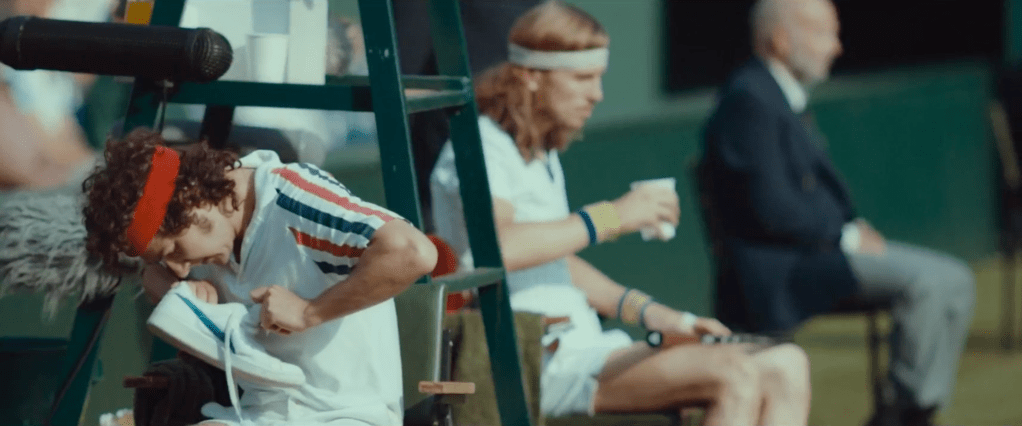
Pedersen effectively captures with almost every frame of the film just how outwardly different Borg and McEnroe are. Borg usually comes on screen quietly; McEnroe’s scenes are often brought on with blaring music or other noise. Borg’s hotel room is clean as a whistle; McEnroe’s room makes him out to be a slob. Borg’s hair is long and smooth, effortlessly perfect; McEnroe’s is a long frizzy mess. One of the best shots in the movie is when both Borg and McEnroe are seated in their chairs during the final. The camera focuses on McEnroe as he wildly chugs his water, checks his shoe, and towels the sweat off his racket. Meanwhile Borg placidly sips his water behind him. Borg’s famous rituals get a lot of attention here (he always stayed in the same hotel room, sat in the same chair during a match, slept naked ten hours a night in a cold hotel room, and so on) and the film seems to suggest he may have OCD. But as Pedersen takes us through the story, we can see how the differences between the titular characters are largely superficial, and these two men were a lot more alike than what meets the eye. Certainly in their passion, but even in their temperament. This is largely seen in their fixation on each other, as they know throughout the film that they are each other’s greatest opponent.
Borg and McEnroe enter Wimbledon at two very different points in their respective careers. Borg, while only 24, is chasing his fifth Wimbledon title while McEnroe, earlier in his career, is still looking for his first. This difference is apparent throughout the film, with Borg feeling the weight of achieving the feat of five Wimbledon championships in a row, as well as his exhaustion from years of being made into a commodity by fans, reporters, and the tennis market writ large. McEnroe, being in the early stages of his career, has not yet experienced that and never would quite at same level as Borg, though it is apparent that he is desperate to achieve what Borg has.
McEnroe’s obsession with Borg borders on erotic at times. He cannot tear his eyes away from him during a press conference, a large picture of Borg hangs in his childhood bedroom, he expresses disinterest in women throwing themselves at him in favor of being told what Borg is doing right now, he stares transfixed at his name next to Borg’s in his makeshift Wimbledon bracket in his hotel room, etc. This choice only felt natural given that Borg was not only a tennis star in his heyday but a sex symbol. McEnroe himself has admitted to being struck by Borg’s appearance as a child, and that he, along with everyone else, wanted to look like Borg. The film naturally runs with this, with McEnroe not only imitating Borg’s appearance with his long hair and headband, but also wanting to imbody Borg’s very being, with his coolness under pressure and the love he had from the crowds.
Borg’s fascination with McEnroe is a different animal. Perhaps the best way to describe Borg’s emotion for McEnroe in this movie is fondness. Borg can’t seem to help but smile when he sees McEnroe, even when he’s yelling at the umpires. This is also true to life, as Borg has expressed that he liked McEnroe from their first meeting on the court. Within the context of the movie, this fondness appears to be largely rooted in Borg’s believed shortcomings and his frustration with a system that seems to have beaten the love of tennis out of him. It impresses Borg on some level that McEnroe can scream and curse at the officials and crowds and still play the game with laser focus. When Borg was a child, he was suspended from his tennis club for unsportsmanlike conduct not unlike the behavior McEnroe displays. We can see that Borg does have a temper akin to McEnroe’s, he just keeps it contained, and believes that if he lets it out, his game will collapse around him. As another player describes him in the film, he’s not an iceberg, he’s a volcano. Further, as mentioned, Borg appears exhausted with the tennis community throughout the film. While being suspended from the tennis club, the owner chastised him by telling him that tennis was a “gentleman’s sport.” With this in mind, Borg may have felt a certain level of satisfaction seeing McEnroe flaunt any “gentlemanly” decorum, telling the umpires and crowds alike to shove it.
These two giants circle each other throughout the film, and it is a testament to Pedersen’s direction that their relationship feels as absorbing as it does without either of them exchanging a word until well into the third act. Borg watches McEnroe throughout the film and sees him as both a great obstacle he must overcome to achieve his childhood dream and as a representation of his own simmering rage. McEnroe obsesses over Borg as someone he desperately wants to be. If McEnroe beats Borg, the crowds will stop booing, his father will give him the approval he craves, he will finally be the best. Borg is smothered by the weight of expectations and childhood hopes where McEnroe is driven largely by his insecurities. When the two men meet in the Wimbledon finals, only one will win, but both achieve a certain catharsis.
Borg and McEnroe walk into the finals match wanting to win but needing something different. Borg needs to find his passion for the game and his will to win again. Only by finding that can he achieve what he has wanted since childhood: to be a legend in tennis. McEnroe needs to prove that he is more than just a bad temper, but that he’s one of the greats. He needs to prove this to himself, to his father, and to the world. McEnroe believes he can only achieve this by beating the greatest in the game: Borg.
The reaction to both players as they enter the match says it all. The crowd boos McEnroe yet again, as he had previously lost his temper in his semi-finals match and had been acting up throughout the tournament. Borg gets a standing ovation. The irony here being that Borg clearly feels very little about a cheering crowd anymore, while McEnroe desperately wants this. Pedersen sets this up perfectly for both players to achieve their emotional payoff, even though only one can win the match.
Both Borg and McEnroe play brilliantly in this match, though Borg started out slow and McEnroe fizzled a bit mid-match. There comes a point where it looks like Borg is running away with a victory, but something changes. After a time-out, as the two players pass each other, Borg says to a clearly deflated McEnroe, “It’s alright. It’s a great match. Just play your tennis.” This is the first time either lead has spoken to the other in the film, it also came at a point in the match where McEnroe appeared close to losing his temper, and the announcers and crowd seemed to have the same expectation that he was going to go off any second. This moment between Borg and McEnroe appears to be inspired by a real interaction between the two players on a different occasion where McEnroe lost his temper and Borg told him “This is a game. Relax. Take it easy.” Which in turn calmed McEnroe down and inspired him to play better and be on his best behavior when playing Borg. That interaction, according to McEnroe, also made him feel that Borg had accepted him.
The impact is similar in the film. While McEnroe had not yet lost his temper in this match, Borg’s words, which McEnroe may have taken as approval or even praise, light a fire under him. Suddenly he’s playing much better, forcing the fourth set into the famous tiebreaker, which goes on for an impressive amount of time, with both men refusing to give in. We can see how, in the context of this film, approval from Borg lifted McEnroe up exorbitantly, especially in a stadium full of people who appeared to believe the worst of him. He had been booed throughout the film, his father looked disappointed in him every time he lost his temper, but here the greatest player in the world, the player he spent the entire film fixated on, tells him he’s doing a great job. While he had previously been able to play through disapproval from the crowds, against Borg, the finals match at Wimbledon may have been too overwhelming until Borg heaped quiet praise on him.
McEnroe finding his fight again turns out to be just what Borg needs as well, not to win the match, but to want this victory again. He was already on his way to winning Wimbledon and achieving his dream before he showed McEnroe kindness, but when McEnroe comes back, Borg must fight for it. He does not get a cakewalk to his fifth Wimbledon title. First, McEnroe hands him what Borg has described as the worst moment of his tennis career: when Borg loses the brutal tiebreaker in the fourth set. This loss is directed brilliantly, as the audience fully feels that if there were ever to be a moment in Borg’s career where he was going to break his racket, it would have been then. But as angry as he was, he still contains himself. More than that, he is able to get back up and continue to play like the champion he is. He lost seven match points in the fourth set, and most players could not come back from that kind of mental loss. Borg does, and Borg wins.
Borg overcoming McEnroe’s comeback may have made Borg’s victory that much greater for him, giving him a love of the game again, but of course it only made McEnroe’s loss even more devastating. His victory in the tiebreaker was astounding. So hard won that it would have been extremely difficult not to root for him after he won it. Imagine that. The Superbrat became the rootable underdog through great talent and sheer determination. It also helped that he never lost his temper once throughout the match, helping to get the crowd on his side for the very first time. As McEnroe played and played so well, the crowd cheered louder and louder for him. How could they not? McEnroe stated at the beginning of the film that he could make the boos stop by winning Wimbledon, by being the best. One can see that he still felt that way after his loss, as he hangs his head, near tears at a shattering defeat, and eyes his father in the crowd. But this is not so. When his name is called after Borg claims his trophy, the crowd stands and cheers for McEnroe. As the announcer put it, he was not the champion that day, but he won the people’s hearts.
It is in this way that Borg and McEnroe both gave each other what they needed. Borg gave it to McEnroe through a small moment of kindness, keeping him steady and motivating him to play harder. McEnroe gave it to Borg through his incredible resolve in their match. They both needed each other, and it very much feels like both could have only achieved this emotional release with the other. Only Borg could have provided McEnroe with that reassurance, and it was only McEnroe who Borg felt a connection with and who could have pushed him as hard as he did.
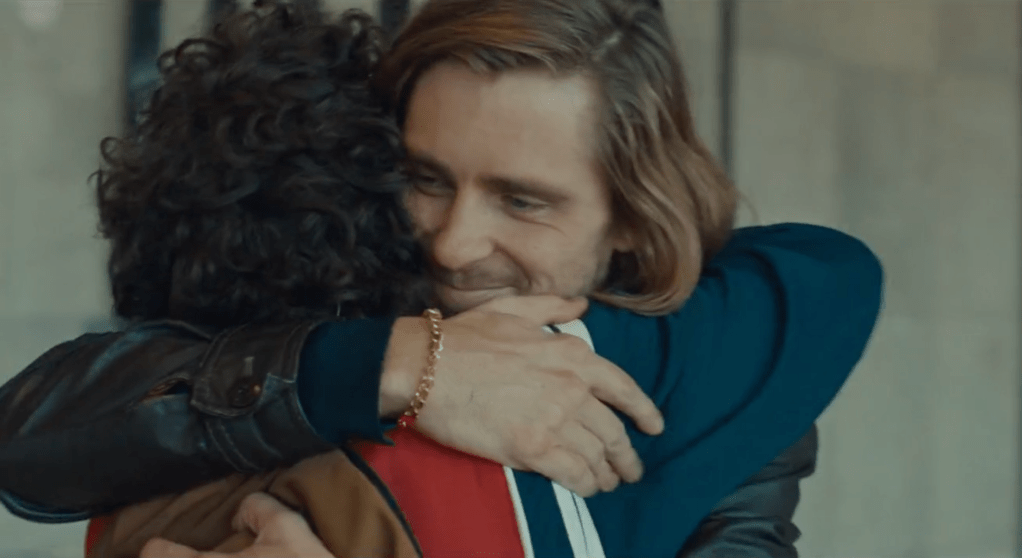
When Borg and McEnroe bump into each other at the airport in the film’s final scene, the audience really does feel a great sense of satisfaction. This is the first time they have an actual conversation, and it happens after hammering each other on a tennis court for hours. Despite this, there is only warmth between them. Borg had not been shown to have much of a relationship with other players, and McEnroe had done well to make enemies. But there is no distance or animosity here as McEnroe teasingly takes an awkward but willing Borg in his arms as they say goodbye. There is only affection. The two had experienced suffering at each other’s hands on the tennis court, and without realizing, both gave the other something he desperately needed. The film makes for a great discussion of the beautiful beginning to what would be a lifelong friendship.
 Liztalks.com