
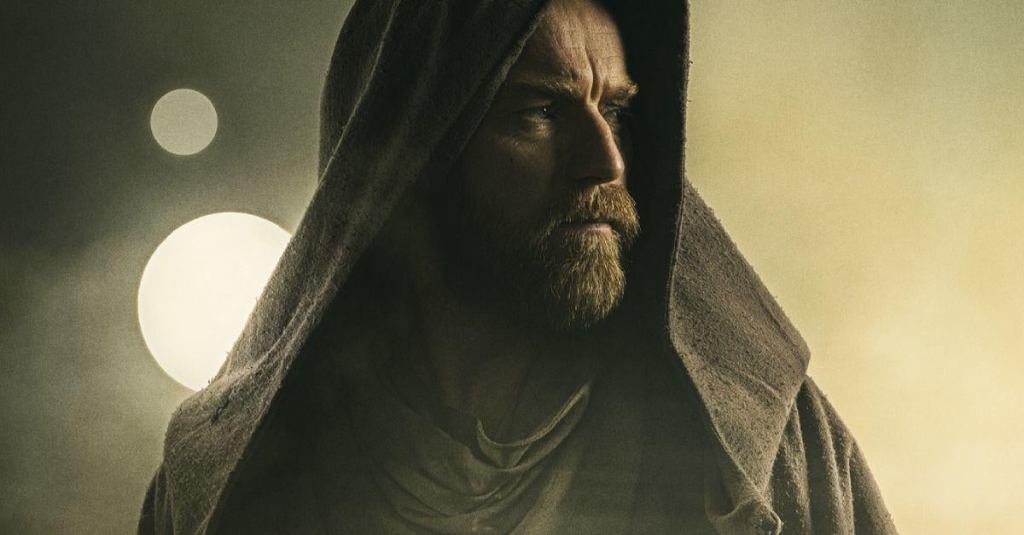
Like most Star Wars fans, when Lucasfilm announced an Obi-Wan Kenobi series on Disney+ featuring the return of Ewan McGregor as Obi-Wan and Hayden Christensen as Darth Vader, I was thrilled. I grew up watching the Star Wars prequels and have appreciated them even more as an adult. But since Disney acquired Lucasfilm, it has been apparent that they don’t hold the prequels in high esteem. They were sparsely referenced in the sequel trilogy, and the director of two of the sequels, J.J. Abrams, is outspoken about his dislike for them. The Obi-Wan series was the opportunity for the prequels to finally get their due, with two of the faces of the prequels returning. Now, finally, Ewan has returned to the role, with Hayden in tow. It felt like a long time coming.
Before the Obi-Wan series was released, we were promised a Logan-esque character driven series. That was exactly what I was hoping for. I wanted the series to look at Anakin’s fall to the dark side and Obi-Wan’s failings as his master. I should say now, because I know Star Wars fans are sensitive about this, that of course Anakin is responsible for his own actions. Obi-Wan did not force Anakin to turn to the dark side and commit atrocities. But I also believe that the Star Wars fandom often neglects to acknowledge Obi-Wan’s shortcomings, and how his behavior and actions drove Anakin closer to the dark side. The show, I hoped, would explore this idea. I wanted to see Obi-Wan grapple with Anakin’s fall, and his role in causing it. What he could have done better as a master to prevent it. Unfortunately, now that the Obi-Wan finale has aired, I can say that the show did not do this, and only covered Obi-Wan’s failure in a superficial way. I was disappointed, disappointed enough that I wanted to write about how this show came up short and really dropped the ball on what could have been an excellent character study.
The prequels showed Obi-Wan and Anakin’s master and apprentice relationship to be a rocky one. Obi-Wan was wary of Anakin when he first met him as a child, and he only agreed to train him when his own master, Qui-Gon Jinn, made him promise to do so before dying in Obi-Wan’s arms. In Attack of the Clones, while we can see the comradery between Obi-Wan and Anakin, there is tension as well. Anakin is outspoken and struggles with being under Obi-Wan’s thumb. When Obi-Wan isn’t around, Anakin often brings him up, usually to mention how Obi-Wan wouldn’t approve of something he’s doing. “He’s overly critical, he never listens, he doesn’t understand.” He tells Padmé. Despite these frustrations, Anakin still refers to Obi-Wan as being like his father, and we can see his emotional attachment to him. He still listens to Obi-Wan and seems desperate for his approval.
Obi-Wan, for his part, does not express his approval of Anakin very often. He believes Anakin to be skilled but arrogant. In some soft moments, due to Ewan’s great performance, we can see Obi-Wan’s care for Anakin, the love in his eyes when he looks at his apprentice. But more often than not, Obi-Wan expresses exasperation with Anakin. This exasperation is often warranted, as Anakin is clearly a handful, but it is apparent that Anakin is looking for something that Obi-Wan either cannot see that Anakin needs or is unable to give him.
Perhaps Obi-Wan’s greatest failing is his disregard for Anakin’s concern about his mother. Anakin dreams that his mother is in danger. His master brushes it off. “Dreams pass in time.” These dreams did not pass. When Anakin goes to his home planet to find his mother (without Obi-Wan’s permission) he finds that she has been kidnapped. He goes to rescue her, and she dies in his arms. This would prove a pivotal moment in Anakin’s path to the dark side and unsurprisingly, he puts a lot of the blame on Obi-Wan, saying that it was his fault and that he was holding him back out of jealousy. Obi-Wan’s dismissal of Anakin’s feelings and fears drove a wedge between them, and pushed Anakin closer to Chancellor Palpatine, someone who was able to fill the void as a compassionate father figure that Obi-Wan was unable to fill.

By Revenge of the Sith, a few years have passed. Obi-Wan and Anakin seem more in tune with each other this time around, at least on the battlefield. They fight like one, and Anakin refuses to leave Obi-Wan behind when Palpatine tells him to do so on a rescue mission. Anakin’s devotion to Obi-Wan is still strong, but the emotional distance remains. Importantly, Anakin and Padmé are married at this point. Crucially, Obi-Wan knows this. That is canon in the novels as well as the Clone Wars series, but even in these two movies in the trilogy, his suspicions are apparent. Anakin went against the Jedi Code and married Padmé. Obi-Wan does not confront him about this or tell the Jedi Council. He allows it to go on. We are not given an explanation as to why. Perhaps he feared losing Anakin if the Jedi found out, which would reveal his own attachment to Anakin, something he supposedly opposes. Perhaps he wanted Anakin to tell him himself, something Anakin would never do, and that on its own is telling.
Soon, Anakin has dreams of Padmé’s death in childbirth, as he had dreams of his mother. He is of course unnerved by these dreams, as they proved true in his mother’s case. But this time, he does not go to Obi-Wan about them. Why would he? Obi-Wan proved unwilling to listen before and to tell him would be to expose his marriage to Padmé. Anakin’s mistrust in Obi-Wan is evident, and it is hard to argue that it’s not justified given what happened to Anakin’s mother. Anakin’s dreams about Padmé’s death would prove to be the final straw in Anakin’s turn to the dark side, as Palpatine is able to use this fear to convince Anakin to join him. Had Obi-Wan shown more compassion to Anakin about his dreams of his mother, or alternatively, had Obi-Wan told Anakin he knew of his marriage to Padmé, and promised that he would not tell the council, perhaps things would have been different.
Anakin’s perception that he was disappointing Obi-Wan continues in Revenge of the Sith. When Anakin loses his temper in front of the council, he and Obi-Wan exchange looks, and Obi-Wan’s expression is one of frustration, maybe even embarrassment. Finally, Anakin expresses this to Obi-Wan, that he believes he’s disappointed him and apologizes. Obi Wan, for the first time, tells him that he is proud of him and heaps approval on him, something Anakin has so desperately needed. Unfortunately, this would prove too little, too late. Palpatine already had his hooks into Anakin, and Anakin was too far gone in his fear over Padmé, two things that Obi-Wan could have helped prevent. The next time they would see each other, it would be as enemies.
While Anakin made his own choices, it would only be natural for Obi-Wan to contemplate what he could have done differently as his master to help prevent Anakin’s fall in the following years. After all, in their duel at the end of Revenge of the Sith, Obi-Wan says to Anakin “I have failed you.” This seems to be an acknowledgement of his shortcomings as Anakin’s master. Obi-Wan himself knew he had done wrong. He also tells Anakin “You were my brother. I loved you.” He never told Anakin he loved him before this moment, and it was something Anakin probably needed to hear. George Lucas seemed aware of how Obi-Wan had come up short as a master, and I hoped to see this further explored in the Obi-Wan series. Did his devotion to the Jedi prevent him from showing Anakin the love he felt for him? And did that love and attachment mean he was a hypocrite of a Jedi? These were interesting questions they could have explored.
The first episode of Obi-Wan Kenobi finds Obi-Wan ten years after the events of Revenge of the Sith living his life on Tatooine. Working a regular job, living in a cave, watching over Luke, and keeping a low profile. It is clear from these scenes that Obi-Wan has been brought low. He has little interaction with anyone and is only focused on getting through each day. He has also cut himself off from the Force and is unable to commune with his former master. At night, he is haunted by his past, remembering the good times with Anakin, the fall of the Republic, Padmé’s death, and what he believed to be Anakin’s death as well. Obi-Wan is under the impression that Anakin died when he burned alive in front of him. He has spent the last decade believing he killed his apprentice and is still traumatized from the experience.
The first episode alludes to Obi-Wan’s guilt over what happened with Anakin. He certainly seems to feel guilty about killing him and the adoptive fathers of the twins, Owen and Bail, also bring up his mistakes. When Obi-Wan says to Owen that Luke will need to be trained as a Jedi, Owen asks him “Like you trained his father?” with no shortage of contempt, as he believes his stepbrother died on Obi-Wan’s watch. Obi-Wan is unable to reply. This moment certainly indicates that Obi-Wan had failed as a master. Later in the episode, Bail arrives on Tatooine to convince Obi-Wan to rescue his daughter. Bail tells him “You’ve made mistakes. We all did.” We get no specificity from either of these scenes about what specific mistakes Obi-Wan had made, but I didn’t expect that from episode one. I thought things were perfectly set up for the show to explore Obi-Wan’s mistakes more in depth.
This would not be the case. The show continues to allude to the mistakes Obi-Wan has made, as he has this exchange with Tala in episode 3:
“I made some mistakes.”
“We all did.”
“I can’t imagine Obi-Wan Kenobi doing anything wrong.”
I kept waiting for them to go further than that. Yes, he made some mistakes, but what were they? Does he know how he failed as a master? How has he changed? In episode 3 Obi-Wan is confronted with his failure in a brutal way when he is found by Darth Vader. Vader, who is obsessed with finding him and exacting revenge. Obi-Wan is no match for him, and Vader smothers him in a field of fire, mirroring his own fate at the end of Revenge of the Sith. It was at this point that I thought the show was getting somewhere regarding Obi-Wan dealing with the consequences of his actions. Obi-Wan had just been made to suffer the excruciating fate he left Anakin to experience. That must have an impact on him, right? Surely, we will see a major moment of his dealing with Anakin’s suffering and how he had put him through a lot of it. I found myself disappointed in episode 4 when the plot kept rushing forward and there seemed to be no time to dwell on how Obi-Wan felt about what just happened to him. He had a brief exchange with Tala about forgetting the past, but it ended there. It seemed like a missed opportunity, to not have Obi-Wan further consider the pain Anakin lives with every day because of their duel.
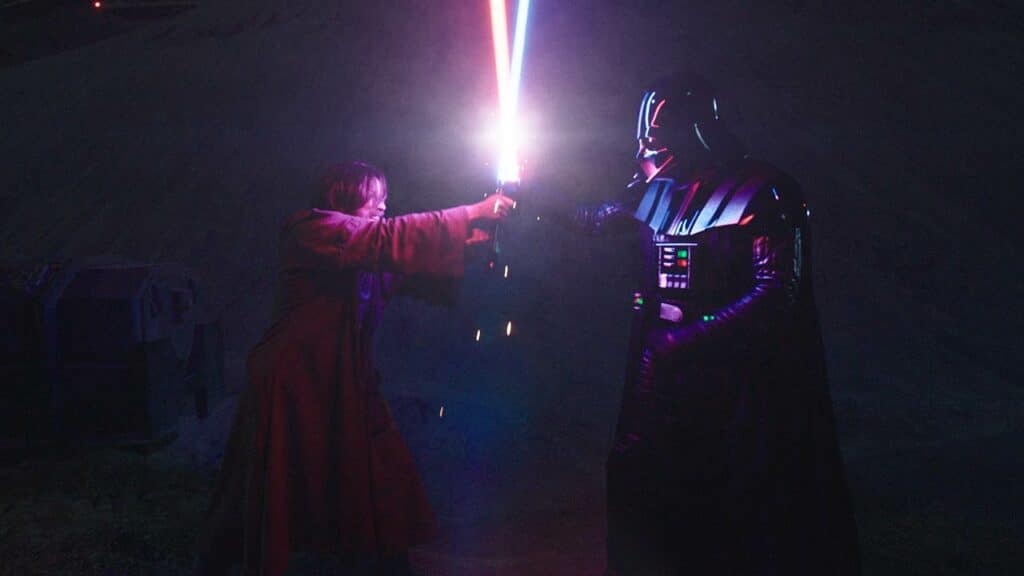
This show had a way of getting my hopes up at the beginning of the episode and letting me down by the end. As was the case in episode 5. We are treated to flashbacks to Obi-Wan and Anakin training together prior to Attack of the Clones. It was a delight to see Hayden in his padawan garb again. He and Ewan played off each other so well. Though I realized quickly that their flashback sparring match was meant to parallel Vader’s present-day hunt for Obi-Wan. Anakin gets overeager, seems like he’s winning, Obi-Wan outsmarts him and wins. We’re told that Anakin’s desire to prove himself is his undoing, as Obi-Wan escapes him yet again in present day. There is something to that, an indication that perhaps even as Vader, he still desperately wants to prove himself to Obi-Wan. He still wants his approval. Though I still found myself let down by this flashback. It felt like they didn’t even crack the surface of their relationship. There is no hint of the mistakes Obi-Wan made as Anakin’s master in those flashbacks, only that Anakin’s desire to prove himself is a serious flaw. We’ve been told that Obi-Wan had made mistakes, but still we’re never told or shown what they were, and in a flashback, we’re shown how Anakin was flawed, not Obi-Wan.
Finally, we come to what we’ve all been waiting for: Obi-Wan and Vader’s final confrontation (until A New Hope anyway). Admittedly by episode 6, I wasn’t exactly on board with the show anymore, but I was still hoping to enjoy the finale. Obi-Wan and Vader confront each other again, only this time Obi-Wan is far more capable of holding his own. The fight comes to an end when Obi-Wan overpowers Vader, hurling rocks at him with the Force, damaging his suit, and slicing his mask so we can see Anakin’s burnt face under the helmet. It is at this point that Obi-Wan stops his attack, seemingly unable to go on, and says Anakin’s name. Then they have this exchange:
“Anakin is gone. I am what remains.”
“I’m sorry. I’m sorry, Anakin. For all of it.”
“I am not your failure, Obi Wan. You didn’t kill Anakin Skywalker. I did.”
On its own, I loved this line from Vader. To me, refusing to view himself as Obi-Wan’s failure was Anakin’s way of seizing agency for himself, as well as a reference to his perception that Obi-Wan was constantly disappointed in him throughout the prequels. He was no longer Obi-Wan’s to be disappointed in. He is Obi-Wan’s nothing. I wasn’t surprised to see that most Star Wars fans seemed to take this line (particularly the “failure” line) differently than I did. The common interpretation seemed to be that the line was Anakin momentarily breaking through Vader to tell Obi-Wan that he did not blame him for his fate and absolving him of any responsibility Obi-Wan may have felt. Hayden Christensen has apparently agreed to that interpretation at a screening of the finale.
If you’ve made it this far into my article, you won’t be surprised to hear that I am not a fan of that interpretation. In part because I do not actually believe that Anakin, as much as he loved Obi-Wan, would have absolved him of his failures. It is also odd to think that Anakin would break through momentarily, only for Obi-Wan to then say, “Then my friend is truly dead.” How can that be if Anakin shone through in that exchange? And of course, I vehemently dislike the idea that Obi-Wan would simply be absolved for his failures as a master and their horrific consequences. I do not care for the message it sends, that Anakin fell because of the evil inside him, not because of anything Obi-Wan or the Jedi more broadly did. In putting the blame squarely on Anakin, the show also absolved the Jedi Order for its arrogance and ignorance that allowed one of their most powerful Jedi to fall right in front of them. Obi-Wan could not save Anakin. Anakin could only save himself. We cannot save others if they have evil inside them. Passing the blame onto Anakin so easily, despite having a whole trilogy where we can see what Obi-Wan did to push Anakin away from him and towards the dark side, was a baffling choice.
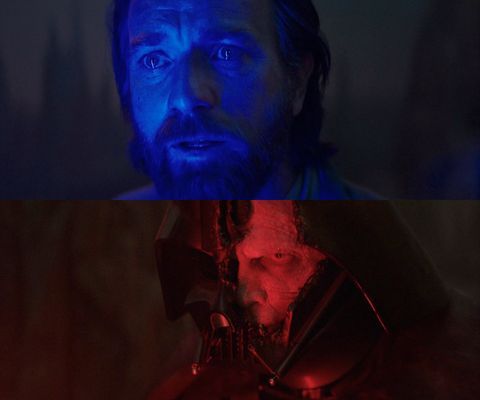
Truly, I’m not exactly sure what Obi-Wan was apologizing for, because the show never went beyond telling us that Obi-Wan “made mistakes.” Based on what we saw in the show, I wonder if the mistake was letting Anakin suffer while being burned alive instead of just killing him. The cruelty of the decision to leave Anakin to die is loosely addressed. But his failings as a master? This show addressed none of that. I do not know if Obi-Wan was apologizing for not being the father Anakin needed, not telling him he knew about him and Padmé, his constant disapproval, or leaving him to burn alive. “For all of it” is a broad statement that the show chose not to delve into, and once Vader tells Obi-Wan that he did not kill Anakin, but Vader did, Obi-Wan bids him goodbye, leaving him barely breathing as Vader shouts his name after him. I found that to be fairly cruel, leaving him to suffer and perhaps die for the second time. Especially knowing that years later he would insist that Luke had to kill Vader to save the galaxy. In episode 1 of this series, Obi-Wan seemed traumatized by the last time he fought Vader, and left him to die. By episode 6, he fights him again and leaves him behind again, and is in high spirits afterwards. The difference seems to be that the second time, he believed he had not done anything wrong.
As mentioned, for the rest of the episode, Obi-Wan is in a good mood. He helps Reva find a new path for herself, he says his goodbyes to Leia, he meets Luke, and he reunites with Qui-Gon. It seems he has found his old self again and found hope. It also read to me that he let go of Anakin and what happened between them. Unfortunately, I feel he got to this place without ever once grappling with his role in the fall of the Republic and Anakin’s fall. He was his old self again, but is that a good thing?
While I would have preferred to see Obi-Wan grapple with guilt over his actions in the prequels, I could also make the argument that he shouldn’t have believed he did anything to cause Anakin’s fall. The Obi-Wan we meet in the original trilogy is a proud man, still loyal to the Jedi Code, and he seems to have distanced himself from his former feelings for Vader. I do not get the sense from any of his scenes that he felt responsibility for what Anakin had become. So, in that vein, what could have been a very interesting approach to this series would have been to show us Obi-Wan’s failings, in flashbacks, visions, or other means to remind us. There also could have been dialogue between him and Vader where we get a sense from Vader why he was so angry with Obi-Wan, beyond the fact that he left him to die. Perhaps the writers could have shown us all of this, but Obi-Wan would still be unable to see that he failed, that he could have done more to help Anakin. His belief in the Jedi Order could blind him to anything he did wrong, and he could have walked away from Vader still believing he had done right, and Anakin’s fall was on him and him alone, while we the audience know better. This would have been a fascinating approach, but it would have involved taking a very negative view of one of the heroes of Star Wars, something Disney was probably unwilling to do. It is a shame, as I think this would have been incredibly interesting, and an indictment on the Jedi Order.
Ultimately, they chose something of a middle ground when approaching this show. They were willing to acknowledge Obi-Wan’s “mistakes” without actually naming them. Obi-Wan apologized without us really knowing what he’s apologizing for. Obi-Wan had to suffer a similar experience as Anakin when he was burnt alive without ever addressing how Obi-Wan felt about that. The show wanted us to know that Obi-Wan was flawed, that he “made mistakes” without Obi-Wan owning up to those flaws, learning, and growing. The show was more about Obi-Wan finding hope again and getting back to his old self than going through any evolution as a character. It was much easier for Obi-Wan to know he maybe messed up and apologize for unclear reasons, and then for Anakin to take the blame on himself. Anakin, Obi-Wan can finally see, could not be saved, and so he can move on with his life, knowing that he really was the good guy all along. I wish things were so simple, that we can brush off the impact we have on other people, knowing that they’re doomed anyway.
 Liztalks.com