

Everyone knows Elvis. Most of us don’t recall learning his name because we cannot remember not knowing who he was. Whether through Lilo and Stitch, an impersonator in a white jumpsuit, or a performer saying “Thank you. Thank you very much” we all know Elvis to the point that he almost feels ingrained in our DNA. With that celebrity status comes the stories of his life in the limelight, some almost mythical. Perhaps the most prominent of those anecdotes are the recollections of the behavior of his female fans.
Women, I have always known, screamed and swooned at the sight of Elvis, especially when he danced while performing. His hip thrusting was a sight to behold for young women in the 1950s. The decade is considered by historians to be one of the most conservative in American history due to the efforts after the Second World War to send women back into the homes after a brief stint of economic freedom during the war while their husbands were away. Young women from their sheltered, state endorsed upbringing were suddenly, to public horror, throwing their panties at Elvis Presley as he gyrated on stage.
This unbridled reaction from women made Elvis both beloved and infamous. The FBI named him a “danger to the security of the United States” and specifically cited the carnal reaction to him from youth as the reason. Today, this can be difficult to imagine: the FBI naming someone a public enemy for their hip thrusting and screaming fans. In Baz Luhrmann’s new movie, Elvis, he goes above and beyond to capture not only why women reacted to Elvis the way they did, but how the reaction from women had the police state and White America shaking at the knees. It can be easy to chuckle about the women’s reaction to the rock singer from our current standpoint, but Luhrmann’s film aims to show us that it was no laughing matter at the time. It was rebellion.
When Austin Butler’s Elvis first busts a move in the opening performance of the movie at the Louisiana Hayride, I was suddenly overcome with understanding of why those girls in the 1950s screamed at the sight of Elvis. This is of course a testament to both Butler’s performance and Luhrmann’s direction. Butler goes no holds barred in his performance, and his commitment is admirable. Costume designer Catherine Martin dressed him to the nines and cinematographer Mandy Walker framed these concert scenes with a woman’s perspective. It’s easy to imagine yourself, while watching, as one of those girls in the audience. Elvis’s musical talent is always prevalent, but the shots of Butler’s swinging hips make clear what those girls were screaming for. When the first girl shrieks at the concert, all I could think was “Same, girl.”
As the girls flood the front of the theater to get closer to Elvis, we are reminded through the voiceover of Tom Hanks’s Colonel Tom Parker just how wild this kind of reaction was. Parker seems beguiled by all these screaming women, and he notices one in particular who looks scandalized by Elvis’s performance, restraining herself before finally giving in and screaming along with the rest of the crowd. This girl, Parker could see, was “having feelings she wasn’t sure she should have.” Of course this girl wasn’t sure she should have a reaction to a man on stage swinging his hips in a suggestive manner. It’s moments like that in movies when I recall my own mom telling me stories about how her mother told her she’d go to hell if a man ever touched her. It’s this, the shame women have for their sexual desire, that Luhrmann captures in this moment, and perfectly defines Elvis as, what Parker calls, “forbidden fruit.”
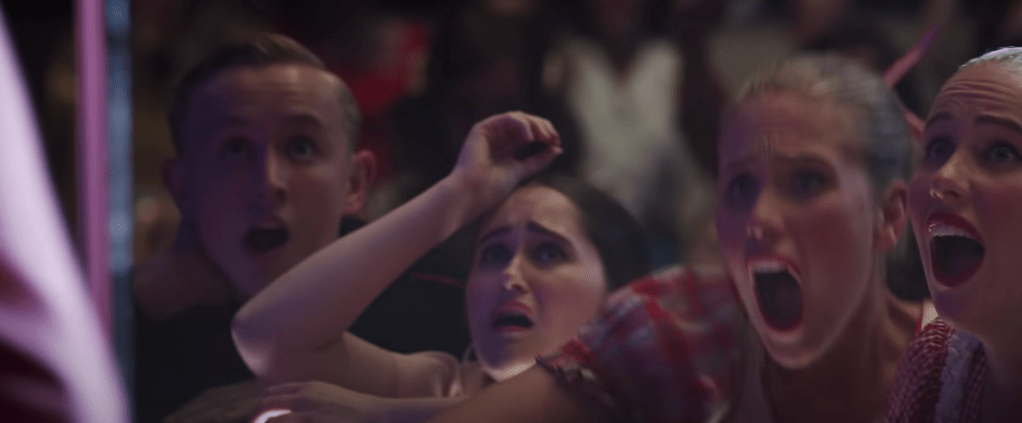
With Elvis’s performance style and the reaction from audiences, his star rapidly rises. But after performing on the Ed Sullivan Show for the whole country to see, he is met with backlash. Senator James Eastland, a staunch Mississippian segregationist, connects his performance style with that of Black artists at the time, Black artists who Elvis infamously took from, to strike fear in White America. Their precious white daughters could not be subjected to this kind of behavior. The backlash rolls on, much of it true to life. He was banned in cities like Boston, ordered by judges to stay still on stage, and much to his chagrin, nicknamed “Elvis the Pelvis.” His dance moves, the press and state pushed, were a threat to American civility, igniting lascivious urges in the hearts of youth.
While Elvis is generally regarded as a resolutely heterosexual figure, especially given the stories of women’s reactions to him, Luhrmann contends in his movie that this sexual awakening was far from a Straights-Only Revolution. In Elvis’s first performance, he is wearing a pink suit, lace top, and as Parker describes, “girly makeup.” One of the men in the audience jeers at Elvis, calling him a “fairy” before Elvis proceeds to make his girlfriend swoon over his dance moves. Here we see something not often discussed regarding Elvis, his early challenging of gender norms, something social media heaps praise on male celebrities for doing today.
Luhrmann goes further, as in every concert scene packed with swooning women, one can also spot a few men staring at Elvis slack jawed. As Senator Eastman’s family watches Elvis on Ed Sullivan, a young man in the room watches Elvis with barely concealed lust on his face. Luhrmann also seemed to imply that a fellow performer on Elvis’s first tour Jimmie Rodgers Snow had a crush on him, staring at Elvis as he danced and saying, “I don’t know what I’m thinking.” The 1950s were particularly unfriendly decade for LGBT+ people, with the American Psychiatric Association listing homosexuality as a mental disorder in 1952 and President Eisenhower banning people guilty of “sexual perversion” from federal jobs the following year. It would be in the 1960s when the gay rights movement would make significant gains. With the shots of men experiencing their own sexual awakening while watching Elvis, Luhrmann makes clear that the state’s fear of Elvis extended beyond the reaction to him from women.
With the backlash against Elvis reaching a fever pitch, Parker determines that his client needs a new image. He repackages Elvis in a suit with a tail and sends him on the Steve Allen Show as “the new Elvis” to sing Hound Dog to a basset hound in a top hat. This is as ridiculous as it sounds. You can practically hear Luhrmann off camera telling us “They seriously did this because they were so afraid of his performance style.” Elvis does not take this embarrassing television appearance well, knowing that he was pleasing no one. People who hated him were not going to get on board and people who loved him would only be disappointed. He was also naïve enough to believe that there was a chance he would get arrested for performing his way, though that fear likely stemmed from his father’s own stint in prison. This is what the press, the state, and even his management ordered, so what was he to do?
Elvis has something of a character arc in each decade presented in the movie. His arc in the 1950s is largely about understanding his own power, and it’s after the Steve Allen show that he does. After a conversation with B.B. King in which King tells Elvis simply that too many people are making money off him for him to face any real consequences, Elvis seems renewed as he heads to his next concert. His police escort makes clear to him that he is to stay still for the duration of the concert. Elvis, we can already see, has no intention of listening. When he goes on stage, he tells the audience that he wouldn’t be listening to the people trying to change him and declares, “I’m gonna show you what the real Elvis is like tonight!” Before performing Trouble, a song that seems designed to whip an audience into a frenzy. Elvis throws his hips forward, falling to his knees, inviting anyone who can reach to touch him. There is a line of National Guardsmen attempting to block his fans from the stage, and the fans continuously push against them. Elvis at one point makes his way into the crowd, letting his fans tear into him. The crowd grows riotous, and Parker orders the concert over and Elvis off the stage. The security drags him away, fans chasing after him as he’s thrown into a police car and shepherded off.

Riots at Elvis concerts were commonplace at this stage of his career. It was largely the fear of riots that prompted judges and police officials to order Elvis to stay still on stage. Despite the seriousness of riots, there certainly is an edge of humor to riots breaking out because young women were so frenzied over the swinging of this man’s hips. Luhrmann presents some of the humor in the lustful reaction to Elvis. It’s hard not to chuckle at the screams of these young women, though Luhrmann is always careful to present the humor of it without laughing at the women. Lesser directors making movies today often make a joke out of sex and desire, which is just a sneakier form of sex negativity. But in Elvis, it is always clear that the women’s reaction, funny as it may be, is the result of a cultural clampdown on their sexuality, and that is anything but funny.
Elvis’s rejection of the police state’s orders is presented as a vociferous rejection of 1950s conservativism. Whether this was actually Elvis’s intention, as it is true he often ignored these commands at his concerts, of course we cannot know. But Luhrmann uses Elvis a vehicle to present his own rejection of the politics of that era, which unfortunately follow us to today with the recent overturning of Roe v Wade and fresh attacks on LGBT+ rights. Luhrmann gives the finger to a state that seeks to control, suppress, and divide, all tools of fascism, in this scene. He takes our modern humorous way of looking at this scenario, the cops told Elvis to stop his wiggling haha, and reminds us that this was not something taken lightly, and that kind of policing of an artist is something to be feared and rebel against. Elvis was radical, Luhrmann says, not because of the mythical hip swinging, but for doing what he wanted with his own career despite what the dominant class told him.
While watching Butler’s Elvis perform Trouble at that concert, I was struck by how much I wanted to be there, screaming along with the rest of his fans. Luhrmann does not present this concert as the horror show that the state believed it to be, or the goofy recollection from present day, but he presents it in the way the audience felt at the time: like freedom. Women and men free to scream their heads off, push past National Guardsmen, and grab at the man of their desires as he enters the audience. Of course, the danger of this is recognized, but the elation is treated with reverence, not contempt. It feels less and less common in recent movies for the passions of people, particularly women, to be depicted in this way. Not as something to be afraid of, or to laugh at, but something to admire, strive for, and find freedom in. Basking in our own joy and desire, Luhrmann shows us, is a radical act.

